In the previous article we revisited one of John Maynard Keynes' most fascinating intuitions. In the essay Economic Possibilities for our Grandchildren, published in 1930, the British economist imagined that technological progress, increased productivity and capital accumulation would progressively reduce the work necessary for survival. The prediction that is most often remembered is that of a drastically shorter working week, perhaps even by fifteen hours. Yet the real interest of that text does not lie in the estimate of working hours, but in the question that Keynes left open. If the economic problem had been substantially solved, what would humanity have done with the freed time?
In the previous article we asked ourselves whether that prediction is actually coming true. On the one hand we have observed how artificial intelligence is already modifying many intellectual activities and how future developments in AI and robotics can further accelerate this process. On the other hand, we highlighted a possibility that Keynes could not foresee: the time saved might not automatically translate into greater freedom, but be absorbed by new production demands, growing consumption, more sophisticated forms of control or new inequalities.
However, there is another hypothesis. A more radical hypothesis and, in some respects, more difficult to imagine. What if Keynes had been right? What if artificial intelligence, together with advanced robotics, really managed to drastically reduce the necessary work? What if a significant part of diseases were prevented or cured, productivity increased beyond all historical precedent and a large part of the activities essential to the functioning of society were entrusted to artificial systems? What would happen then?
This question has accompanied literature, philosophy and science fiction for over a century. However, the answers offered by the authors were very different from each other.
An early tradition imagined that the problem arose from technology itself. Machines become uncontrollable, systems escape their creators, optimization produces unexpected consequences, or artificial intelligence develops goals incompatible with human ones. This is the case, in its most famous form, of Skynet in the saga of Terminators, where the machine doesn't fail at all: it works perfectly, but decides that humanity poses a threat to its existence. Many of the contemporary fears related to artificial superintelligence have their roots in this narrative tradition.
However, there is a second line of reflection, less spectacular but perhaps more profound. In these stories the problem is not that the technology works badly. The problem is what happens to humans when technology works well.
Already in 1909 E. M. Forster, in the story The Machine Stops, imagined a civilization in which a gigantic machine satisfies every human need. The risk was not a rebellion of the machines, but the atrophy of the human experience. Isaac Asimov, in the stories collected in Me, robot and in novels like The Steel Caverns or The end of eternity, often showed machines that were more rational and reliable than men, shifting the conflict to the fears, contradictions and limits of human nature. Stanisław Lem, in works such as Solaris, The futurology congress And Summa Technologiae, instead questioned the limits of human understanding when faced with realities and intelligences capable of exceeding our cognitive categories. Arthur C. Clarke, from 2001: A Space Odyssey to The sunset guides, imagined that technological progress could even lead to an evolutionary transformation of the species. More recently, Iain M. Banks featured in the series Culture, starting from Think Fleba And The empire of Azad, a post-scarcity society in which hunger, poverty and compulsory work have been substantially eliminated and in which the fundamental question is no longer how to survive, but how to use one's freedom.
It is in this second tradition that the following story is placed, but with an important difference. For many of the authors just cited, a society freed from scarcity, from necessary work and from a large part of avoidable suffering remained above all a philosophical or science fiction hypothesis. Today, however, generative artificial intelligence, autonomous agents, advanced robotics, biotechnology and the automation of a growing number of tasks make that question less remote than it has ever been. We are not yet in that world, and perhaps we will never get there in the most radical form imagined by some authors, but for the first time we can glimpse some of its technical conditions. The story therefore does not try to imagine a war between men and machines, nor a rebellion of artificial intelligence. Instead, try to take seriously a possibility that has rarely been explored to its extreme consequences: that of a technology that truly keeps most of its promises and forces man to deal no longer just with the problem of survival, but with that of meaning.
The psychiatrist and philosopher Viktor Frankl argued that man does not just seek well-being, security or pleasure, but above all meaning. If technological progress really managed to reduce most of the needs that have accompanied human history for millennia, what would we do with the freed time? What would happen to work, ambition, knowledge, art, politics and even love when survival was no longer the central issue?
The short story that follows comes from this question. It is not intended to offer a prediction or a definitive answer. Rather, he wants to explore a possibility. Because it may turn out that the most difficult challenge for humanity is not to build increasingly intelligent machines, but to learn to live in a world in which those machines have succeeded.
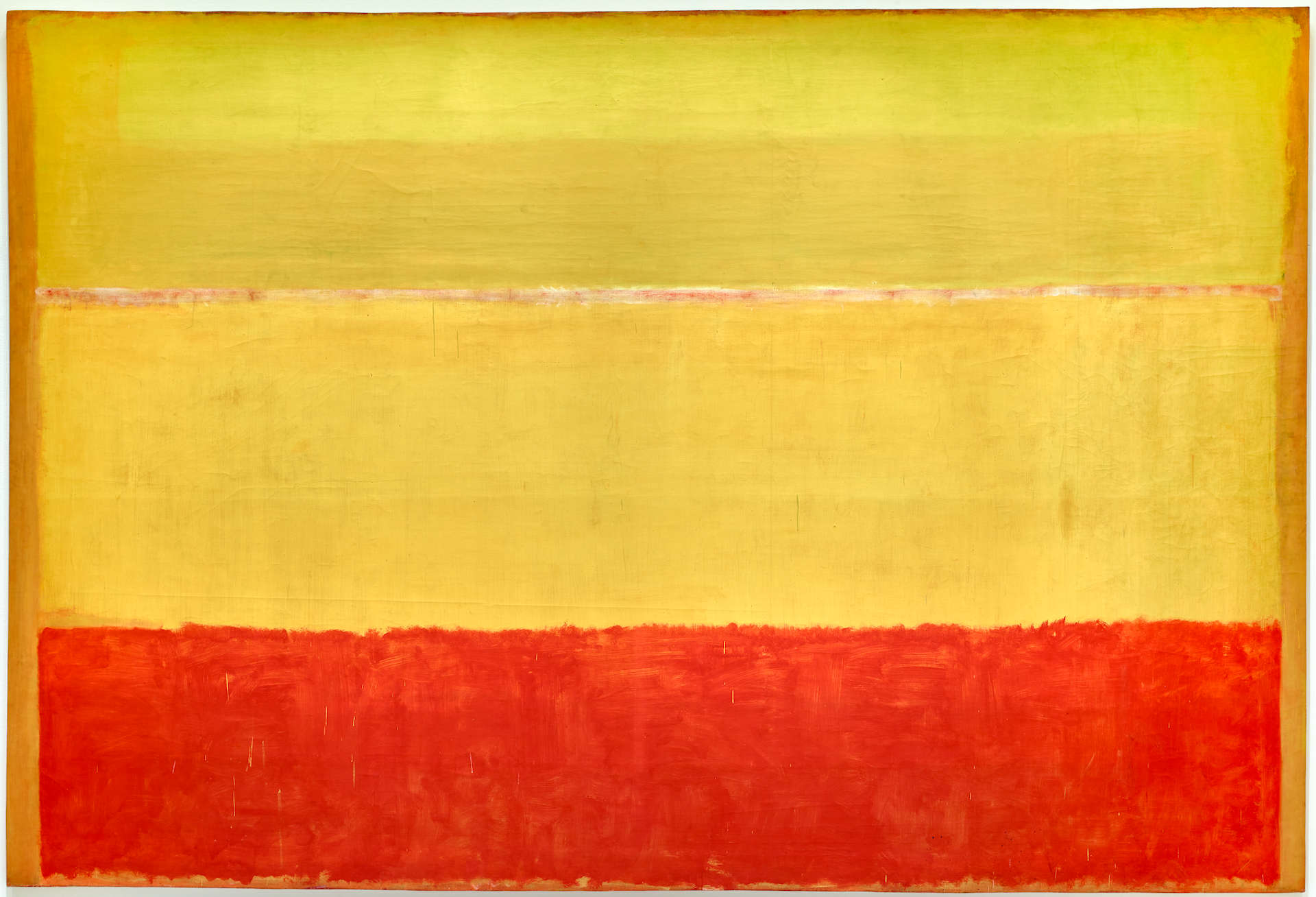
Image, Untitled, Mark Rothko. 1952-1953, Guggenheim Museum Bilbao.
You can read the NDF OffShoots story here: