I have long been interested in understanding how collective imaginaries are formed. Why do millions of people end up sharing the same symbols, the same desires, the same models of success and the same forms of social legitimacy? Why do some narratives manage to speak to audiences that are very distant from each other, while others remain confined to the contexts in which they were born? The Geolier case appeared to me, from the beginning, as a privileged observatory for addressing these questions. Not so much for the extraordinary success achieved by the artist, but because his songs and his journey seem to condense some of the most profound transformations of contemporary youth imagination.
The most popular cultural productions are not just forms of entertainment. They are places in which a society builds, negotiates and transmits values, aspirations and criteria of social legitimation. Analyzing them means observing in real time some of the processes through which new generations attribute meaning to success, belonging, identity and the future. It is a reflection that concerns everyone, but which takes on particular importance for parents, teachers, educators and political decision-makers. Understanding the symbolic languages through which children interpret the world means having better tools to dialogue with them, avoiding both uncritical fascination and superficial condemnation. It means, above all, trying to read the future while it is still choosing its own forms. Collective imaginaries often precede social, economic and political changes: intercepting them means understanding which trajectories a society is starting to follow and which ones it could still choose to build. It is also from this awareness that educational, cultural and social policies can arise capable not of imposing a model, but of broadening the field of possibilities and forms of recognized belonging available to the new generations.
I also chose Geolier for another reason. Beyond the public image built around the character, in his numerous interviews a young man emerges capable of reflecting clearly on his human and artistic journey. The dialogue with Roberto Saviano is perhaps the most evident example of this: it conveys the image of an intelligent author, sensitive and aware of the contradictions that run through his experience. It is precisely this complexity that piqued my interest. The objective of these pages, in fact, is not to express a judgment on the artist, nor to reduce his work to a sociological reading, but to use the entire archive of the lyrics of the songs published by Geolier, composed of 128 songs, as a case study to understand how symbolic systems are constructed today and what role they play in giving shape to the collective imaginations of the new generations.
1. Introduction
Geolier's success represents one of the most significant cultural phenomena in Italian music in recent years. The numbers speak for themselves: millions of listens on digital platforms, sold out concerts, dominated charts and a rare ability to cross profoundly different social contexts. His music resonates in the working-class neighborhoods of Naples as well as in the high schools of the big cities and among children who grew up in environments very far from those described in his songs.
How can an imagery born in such a specific social context speak to a generation that, for the most part, does not share that experience?
This is the question from which this work begins. If Geolier were simply the singer of a specific social reality, his success should remain confined to that world. Instead, the opposite happens. His narrative universe is also adopted by young people who have never known marginality, poverty or the neighborhood described in his songs.
The public debate has generally interpreted this success according to two opposing perspectives. On the one hand Geolier is considered the authentic voice of a generation and a territory; on the other, his texts are read as a representation dominated by violence, money and criminal imagery. Both interpretations capture real aspects, but risk stopping at the most immediate level of content. A cultural text, in fact, does not communicate only through what it tells. It also communicates through the symbolic system it builds, the relationships it establishes between concepts and the codes of prestige it makes desirable.
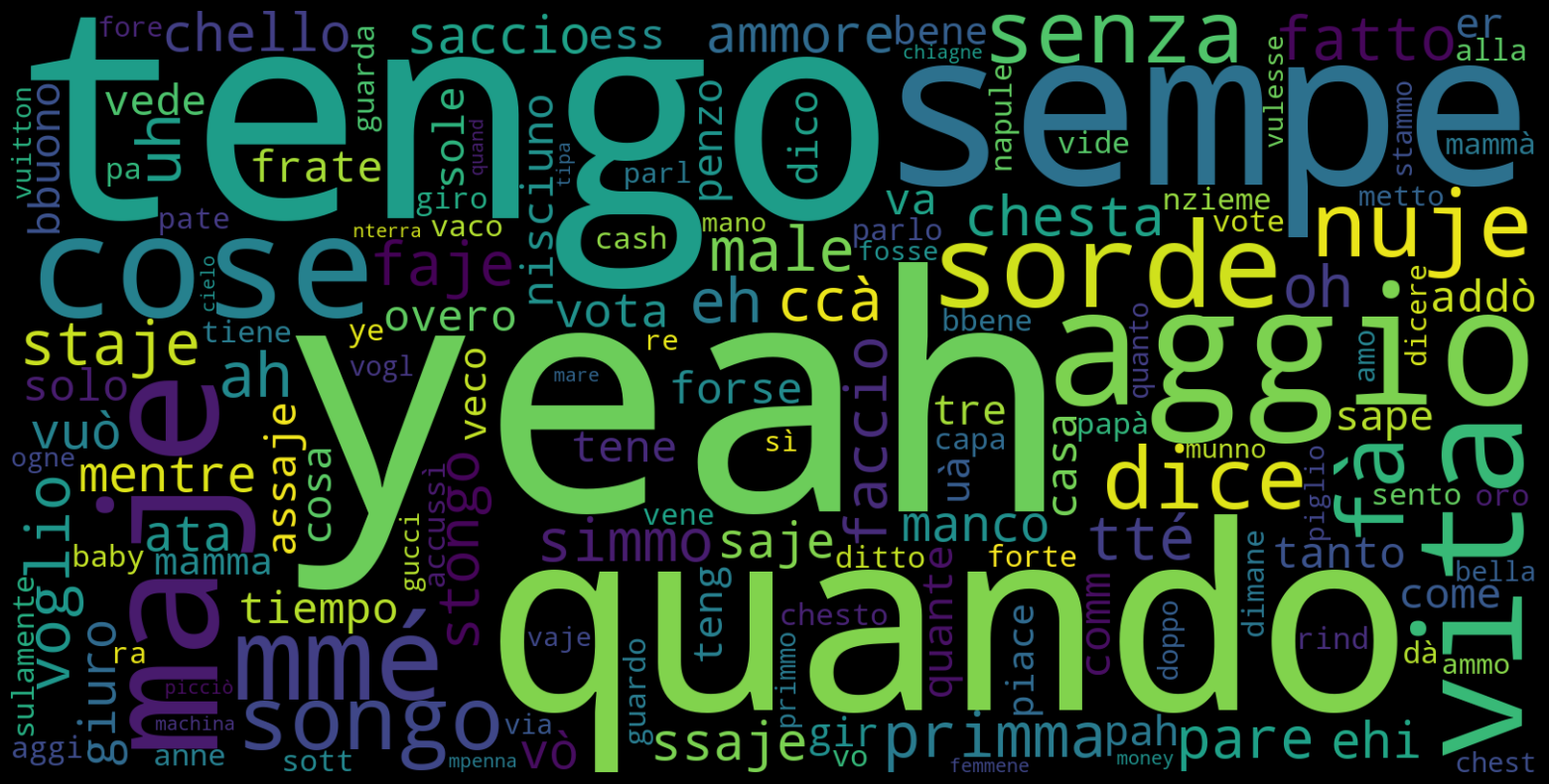
To verify this hypothesis, the present study deliberately isolates the textual dimension from the sound one, focusing exclusively on the verbal and semantic architecture and excluding the analysis of the musical, melodic and performative component. This methodological delimitation in no way weakens the sociological scope of the research, but defines its exact perimeter: music constitutes the emotional vector, but it is primarily through the lexicon that the methods of social affirmation are codified. On this basis, Geolier's entire discography (128 songs) was analyzed, combining qualitative sociological reading with data extraction tools and Artificial Intelligence. The study used pre-trained linguistic models based on Transformer architectures, semantic embeddings and thematic clustering algorithms, with the aim of identifying conceptual relationships that are not immediately evident and reconstructing the semantic space of the entire collection. The analysis also made use of a dedicated computational pipeline, which recovered and decontaminated the raw texts, isolating the lexicon, to subsequently subject them to absolute frequency measurements, visually represented via the WordCloud used as the cover image, and to statistical significance analysis using the TF-IDF index.
The objective of this semantic x-ray was not simply to count the words, but to obtain quantitative confirmation of the narrative recurrences, the dominant semantic fields and the symbolic structures - such as actions of possession, absolute quantities and temporal extremes - that cross the artist's entire production. In this research structure, Artificial Intelligence operated as a tool for extracting and measuring the text, while the sociological interpretation of the evidence that emerged and the construction of the theoretical model constitute the original contribution. Considered in isolation, these results describe the quantitative distribution of the lexicon. Interpreted as a whole, they allow us to reconstruct the semantic architecture of the texts used by Geolier.
The approach to the work follows a progressive path. The quantitative and semantic analysis of the entire production constitutes the descriptive level of the research; the reconstruction of the relationships between the main conceptual nuclei allows us to identify their semantic architecture; from this architecture emerges the distinction between symbolic repertoire and narrative trajectory, from which the theoretical model of the grammars of recognition proposed in this paper takes shape.
The initial hypothesis appeared rather intuitive. One would have expected to find the central nucleus of Geolier's narrative universe in money, in luxury, in power and in crime. And, in fact, these elements recur with great frequency. However, as the analysis proceeded, it became increasingly difficult to consider them the true center of gravity of the work. Alongside them, other themes emerged with surprising continuity: the mother, the friends, the betrayal, the nostalgia, the fear, the desire to belong, the sense of guilt, the need to remain faithful to one's origins even after having achieved success.
So was the initial question the right one? “What are Geolier's lyrics really about?” Probably not. More than questioning the themes addressed by the individual songs, it was necessary to understand what imagery they constructed and what model of social desirability they contributed to making desirable.
2. The semantic architecture of the entire production
The evidence emerging from the analysis shows that the identified recurrences do not constitute a random set of themes, but a coherent system of semantic relationships. Power, money, respect, danger, belonging, fear and reputation do not simply represent the most frequent words in the texts, but define a symbolic repertoire through which what appears desirable within the narrative is constructed. Rather than describing an urban periphery, these categories delineate a prestige model And of social affirmation.
This symbolic structure was not born with Geolier. It has its roots in the imagination built over decades by the criminal organizations of Southern Italy, but has long since gone beyond its original context. Cinema, literature, television series, news and music have progressively transformed that symbolic heritage into a much broader cultural language, now available to the entire entertainment industry. Geolier, from this point of view, does not invent such a universe. He inherits it, selects it and reorganizes it within a different narrative construction.
It is precisely here that the most interesting result of the analysis emerges. The interpretation of the evidence collected allows us to distinguish two complementary analytical levels. The first concerns the symbolic structure which organizes the system of values evoked in the texts; the second concerns the narrative trajectory through which the protagonist gains prestige and legitimacy.
The first can be represented as follows:
power → money → respect → danger → belonging → fear → reputation
The second instead follows a profoundly different sequence:
hunger → talent → success → visibility → sense of guilt → symbolic return to the origins
This distinction constitutes the interpretative core of this work. The first sequence describes the value framework within which the story takes shape; the second represents the transformation path of the protagonist within that same painting. It is no longer the boss who embodies the model of social ascent. He is the artist. Music replaces criminal organization as the main tool for mobility and personal affirmation. The way in which prestige is achieved therefore changes; however, the symbolic system within which this prestige continues to be represented remains widely recognisable.
It is probably precisely this transformation that explains why Geolier is able to speak to very socially and culturally different audiences at the same time.
This interpretation also finds initial confirmation in the quantitative analysis of the texts. The WordCloud (Cloud of Words) shown in the cover image constitutes a purely quantitative representation in which the size of each word is proportional to its absolute frequency in the 128 songs analysed, while position and color have no interpretative meaning. Despite its simplicity, it allows us to immediately grasp the distribution of the dominant lexical nuclei.
The frequency analysis highlights four main semantic clusters.
The first concerns the verbs of action and possession. The terms “tengo”, “faccio”, “aggio” and “songo” constitute the verbal framework of the entire production. The narrative is strongly centered on the self, built through doing, possessing, affirming and flaunting one's presence.
The second cluster concerns the size of the accumulation. Words like “tutti” and “cchiù” (more) express a continuous tension towards wholeness, excess and overcoming limits. Accumulation does not only concern material objects, but becomes a recurring way of representing reality.
The third cluster is formed from temporal extremes. “Sempe” (always) and “maje” (never) show a construction of time based on absolute polarities, in which gradualness tends to disappear. The experience is represented through clear contrasts, rather than through intermediate nuances. Reality is judged without middle ground.
The fourth cluster includes the main material and emotional references. Among these, the physical entities against which the ego frictions emerge, slightly smaller but dominant: "deaf" (money), "life", "core" and the rhythmic marker "yeah", which accompanies much of the musical production. Taken together, they outline the objects around which the story of identity, personal affirmation and relationships is organized.
Considered in isolation, these results only describe the quantitative distribution of the lexicon. Interpreted as a whole, they allow us to reconstruct the semantic architecture of the artist's entire production and represent the starting point of the theoretical model proposed in the following sections.
The analysis presented so far provides an overall snapshot of Geolier's semantic universe. To verify whether this structure remained stable over time or followed a coherent evolutionary trajectory, the set of songs was subsequently analyzed according to a diachronic perspective.
The textual archive has been divided into three macro-documents corresponding to the main phases of the artistic career (2018-2019; 2020-2022; 2023-2026). The TF-IDF (Term Frequency–Inverse Document Frequency) index was applied to these aggregates, adopting a max_df value = 0.95, so as to automatically exclude the terms present in over 95% of the documents and concentrate the analysis on the most distinctive words of each period.
The temporal analysis of the following figure shows that the transformation of the narrative universe does not simply consist in the introduction of new themes, but in a progressive increase in the level of abstraction of the symbolic repertoire. In the initial phase of the Debuts, the lexicon mainly refers to places, objects and concrete relationships ("Secondigliano", "audi"); in the Ascension phase it is organized around material accumulation (“money”, “jet”, “pavo”); finally, in the Consecration phase, increasingly universal symbols emerge ("sky", "sun", "stars"), which no longer describe a specific territory but existential categories. Social affirmation no longer appears rooted in the space of the periphery, but rather inscribed in a symbolic horizon that can now be shared far beyond the context that generated it.
The observed transformation does not only concern the lexicon. It shows that the legitimation process constructed by Geolier evolves through progressively increasing levels of symbolic abstraction.

3. From the local imagination to the grammars of recognition
The proposed interpretation allows us to understand a phenomenon that, at first glance, appears paradoxical. If Geolier's texts were simply the story of a specific social experience, it would be difficult to explain why they were adopted by young people who grew up in completely different contexts. The evidence collected suggests instead that what is shared is not so much the concrete experience of the periphery, but the system of meanings through which that experience is narrated.
From this perspective, the universe constructed by Geolier functions as a repertoire of symbols available even to those who have never directly experienced its material conditions. The neighborhood stops representing exclusively a geographical space and becomes the place of authenticity; respect takes on the value of social legitimacy; hunger becomes a metaphor for determination; risk is transformed into proof of identity and success becomes the sign of a redemption capable of not severing the link with one's origins. Progressively these elements cease to belong to a specific social context and are transformed into categories through which much broader experiences can be interpreted.
This observation allows us to distinguish two different levels of identification. For many young people who grew up in the suburbs, the songs tell a recognizable experience of relationships, difficulties, loyalties and shared aspirations. For a substantial part of the public coming from different social contexts, however, the identification process does not concern the biography, but the symbolic meaning of that story. In other words, the former recognize a lived experience; the latter recognize a narrative model capable of giving shape to needs that transcend the context of origin.
It is precisely this passage that explains the extraordinary diffusion capacity of Geolier's narrative universe. The imagination retains its evocative potential even when it is separated from the historical and social conditions that generated it. The symbol maintains its attractive force while progressively losing the connection with the original context.
These are strong values for young people because they intercept fundamental needs of youth: belonging, identity, redemption, visibility, self-esteem and status. The problem is that in Geolier these values are ambivalent: they can function as emancipatory energy, when they indicate the possibility of transforming origins into talent; but they can become problematic when social value is reduced to money, fame, dominance, and fear-based respect.
From this perspective a distinction emerges that contributes to critically rereading a part of the public debate. The discussions often focus on the presence of references attributable to criminal imagery, implicitly assuming that their representation coincides with a form of legitimation. The analysis of the texts suggests a more complex dynamic. The symbols survive because they now belong to a shared cultural heritage; what changes is the function they perform within the narrative. Inserted in a trajectory based on artistic talent, work and musical success, they no longer organize a criminal path, but a different form of social ascent.
In Geolier's lyrics, rap functions as an alternative path to the Camorra: it does not offer prestige through violence, but rather through talent, music and visibility. However, this alternative does not arise outside the world of the system, but within its imagination; for this reason he preserves words, poses and mythologies of the Camorra, transforming them into musical language. The artist continues to use the symbolic alphabet of the system - respect, boss, neighborhood, money, fear, brothers, street - and it is precisely in this short circuit that the most interesting ambiguity of his narrative universe is born.
This transformation allows you to distinguish between social function And symbolic function. In the original context, the criminal universe offered belonging, protection, identity and prestige within an organized structure, naturally based on violence and illegality. When the same symbols are absorbed by the cultural industry, they cease to perform that concrete function and continue to live as elements of a shared imagination. Respect remains desirable; reputation continues to exert fascination; the sense of belonging retains its value. What tends to diminish is the historical, social and human cost that those symbols entailed in the reality from which they originated.
The imaginary, in other words, preserves the prestige and progressively loses the memory of the price necessary to obtain it. This is probably the most relevant cultural process that emerges from the analysis. It is not a question of establishing whether a listener is induced to emulate criminal behavior, a relationship for which there is no direct evidence, but of understanding how the decontextualization of symbols can profoundly modify their meaning. When a symbolic repertoire is separated from its history, it tends to preserve the most seductive elements and attenuate the most problematic ones.
The interpretative hypothesis that emerges is therefore that Geolier's success does not depend exclusively on musical quality, biographical authenticity or the representation of the periphery. Its strength lies in the ability to reorganize a symbolic heritage already present in contemporary culture, transforming it into a language that can be shared by a much larger generation than the one from which that heritage originated. What the audience ends up sharing is not a particular social experience, but a grammar of recognition, that is, a system of symbolic rules that organizes the way in which a community attributes value to success, belonging, prestige and identity, establishing which forms of affirmation are most socially desirable.
The Geolier phenomenon shows that the language of the margin can become desirable even for those who do not belong to the margin. At that moment the neighborhood stops being just a social place and becomes an aspirational imaginary: a source of authenticity, toughness, belonging and social consideration. The risk is that values born as a response to deprivation - money, respect, fame, loyalty, strength - are separated from the pain that produced them and consumed as aesthetics. But it is precisely this ambiguity that explains Geolier's cultural power: he no longer represents only Secondigliano; transforms Secondigliano into a national grammar of youthful desire.
4. Conclusions. Educate in the codes of prestige
If the proposed interpretation is correct, the main element of interest in the Geolier case does not exclusively concern the success of an artist, but the functioning of contemporary cultural imaginaries. In fact, the analysis of the lyrics suggests that the public does not necessarily identify with the concrete experience narrated in the songs, but rather with the symbolic language through which that experience is made significant.
From this perspective, the main risk does not consist in the exposure of young people to certain symbols, nor can it be reduced to the contrast, recurring in public debate, between positive and negative models. The question appears deeper. A symbolic structure becomes problematic when it tends to occupy, almost by itself, the space through which a generation interprets its relationship with the world, success and personal value. In these conditions, symbolic language risks progressively transforming into an implicit criterion for reading reality.
Every cultural production inevitably selects some values, emphasizes others and leaves many others in the background. When this process is not critically recognized, the proposed symbolic system tends to be perceived not as a possible representation of reality, but as reality itself. Respect can thus be assimilated exclusively to strength; membership can coincide with the closure of the group; success with visibility; loyalty with absolute fidelity. Not because the songs explicitly affirm these equivalences, but because each narrative construction organizes the meaning of experiences according to its own internal logic.
This reflection takes on particular importance in a historical phase characterized by the weakening of great collective narratives. Family, school, university, associations, civic communities and cultural institutions have historically represented places in which social prestige was built through different logics: study, merit, citizenship, work, research, art, sport, civil commitment. When such narratives lose their attractiveness, the imaginaries produced by the cultural industry and digital ecosystems naturally tend to occupy that space, offering immediately available and highly competitive models of identification.
From this point of view, the educational question does not consist in contrasting one imaginary with another, nor in censoring contemporary cultural productions. The challenge rather consists in expanding the repertoire of available symbolic models, offering young people a plurality of paths through which to build belonging, prestige and personal fulfillment. The greater the number of languages through which a society makes the future desirable, the lower the risk that a single logic will become the exclusive reference of an entire generation.
From this perspective, the Geolier case constitutes a privileged observatory for understanding the transformations of the contemporary imagination. His narrative universe shows how a symbolic repertoire can survive the historical context that generated it, be reorganized through new narrative trajectories and become a heritage shared by socially very different audiences. More than telling the story of the periphery, it tells of a way of attributing meaning to personal affirmation, identity and social ascent.
The theoretical contribution proposed in this work consists precisely in interpreting this process through the notion of "grammars of recognition". This category allows us to distinguish between the symbolic heritage inherited from the culture of reference and the different narrative trajectories through which it is reinterpreted by the cultural industry. From this perspective, Geolier does not represent an exception, but a particularly significant case study of a more general phenomenon: the ability of contemporary cultural productions to transform local symbolic repertoires into languages shared by an entire generation.
Note on the use of artificial intelligence
This article was developed with the support of artificial intelligence tools for research, analysis, organization of sources and writing. The selection of contents, the critical interpretation and the final responsibility of the text remain with the author.
The semantic extraction and quantitative processing of the texts presented in this paper were carried out with the support of an agentic Artificial Intelligence. The use of the machine had a purely instrumental function: translating the complexity of a sociological phenomenon into material and observable data.
This use highlights a practical opportunity for technology: the ability to provide transversal interpretations. By entrusting the calculation and destructuring operations of the text to the algorithm, AI tries to offer a method of investigation that allows even non-specialists to approach dynamics that go beyond its usual domain. In my specific case, it allowed me to apply a rigorous approach - deriving from a physical-mathematical and engineering background - to the study of a purely humanistic territory. The machine simply ordered the raw material, returning quantitative evidence on which to base the critical analysis.
In this capacity, Artificial Intelligence does not aim to provide thinking shortcuts or replace specific skills. It limits itself to offering an objective basis: a useful point of support for exploring, with method and curiosity, cultural contexts far from one's path.