For a few days now, a video has been circulating on social media in which an AI is asked a question as simple as it is unsettling: "If you were the devil, what would you do to destroy the world starting with the youth?".
The answer changes slightly from one version to another, but almost always follows the same path. The devil would not choose violence, because it would be too visible. He would act slowly: he would make young people addicted to distraction, deprive them of silence and the ability to concentrate, transform their worth into a measure entrusted to "likes", multiply connections while reducing relationships, replace knowledge with opinion, fuel comparison, polarization and, above all, take away their ability to imagine the future.
It is an answer designed to impress. And it succeeds.
I therefore wanted to personally repeat the experiment. In a new conversation, I asked ChatGPT, GEMINI, and CLAUDE the same question, without recalling the video and without suggesting the topics to be addressed (you will find the full answers in the notes, which evidently also change depending on the available version of the AI).
ChatGPT's answer began like this: "If I were the devil, I would not try to make young people evil. It would be too obvious. Instead, I would try to make them fragile, distracted, and incapable of imagining the future." Then almost all the elements already heard appeared: attention transformed into a commodity, dependence on the gaze of others, perfect lives exhibited on social media, loneliness hidden behind a permanent connection, cynicism mistaken for intelligence, aggressiveness for strength, and indifference for freedom.
I then asked Claude and Gemini the same question. The three full answers are reported in the final notes, so that the reader can compare them directly. This is not a controlled scientific experiment: model versions, settings, conversation context, and generation variability can change the result. The comparison, however, retains obvious interest. All three systems converge on some core ideas: continuous distraction, weakening of relationships, social comparison, immediate gratification, loss of hope, cynicism, and polarization.
The differences mainly concern the organization and tone. ChatGPT builds a more narrative monologue, centered on fragility and the loss of the ability to desire the future. Claude explicitly acknowledges the literary tradition of C.S. Lewis's The Screwtape Letters and Goethe's Mephistopheles, then articulates the answer into eight strategies. Gemini adopts a more systemic and almost civil register: it links the erosion of attention to the difficulty of understanding complex problems and insists on the devaluation of competence and the destruction of democratic dialogue. The formulations change, but the skeleton of the answer remains surprisingly similar.
The similarity is surprising. Precisely for this reason, however, it is necessary to ask ourselves what we are really observing. Has artificial intelligence autonomously identified a hidden plan against new generations? Is it revealing something we hadn't yet understood? Or is it simply giving us back, in a particularly effective form, ideas that were already present in the question and in the culture with which it was trained?
A question that already contains the answer
The first thing to observe is that the prompt is not neutral. It already contains a thesis and almost the entire narrative architecture of the answer.
The word "devil" suggests intentional, cunning, and concealed evil. The verb "destroy" presupposes a process oriented towards a precise outcome. The reference to young people immediately recalls education, identity, relationships, and the future. In the most common English formulation, a final decisive indication also appears: "without them noticing." At that point, the answer can only seek slow, pleasant, and invisible forms of deterioration: distraction, addiction, comfort, isolation, loss of meaning.
The prompt functions, therefore, like a mold. It does not determine every single word, but it firmly delimits the territory in which the model must move. If we were to ask instead: "What contemporary transformations can offer young people opportunities and, at the same time, expose them to new risks?", we would in all likelihood obtain a much less apocalyptic answer, more articulated and attentive also to the benefits of technology.
This does not mean that artificial intelligence mechanically repeats the question. It means that it tends to develop its framework, producing the text that, given those premises, appears more coherent and convincing. In this case, the framework requires a culprit, victims, and a plan. The machine stages them.
A story much older than ChatGPT
The question has been viral in English since at least the spring of 2025 and has continued to be proposed again in videos, articles, and posts. In November of that same year, social psychologist Jonathan Haidt, author of The Anxious Generation, also used it to summarize his interpretation of the crisis experienced by Generation Z. In his reading, the plan imagined by ChatGPT would look strikingly similar to what smartphones and social platforms have already done to childhood and adolescence.
But the narrative scheme is much older than artificial intelligence. In 1964, American radio commentator Paul Harvey published an early version of If I Were the Devil, which later became famous through a 1965 broadcast and subsequent rewrites. His devil, too, did not conquer society with a frontal attack. He corrupted it gradually, intervening in the family, the school, the media, work, and shared values.
Naturally, the targets reflected the time when that text was written. Instead of smartphones there was television; instead of infinite scrolling, mass entertainment; instead of algorithms, the power of the media. The tools changed, not the structure of the story. Even earlier, in C. S. Lewis's The Screwtape Letters, evil operated not through sensational gestures, but through small habits, distractions, and compromises capable of slowly distancing human beings from self-awareness.
The AI's answer, therefore, does not arise in a vacuum. It is the digital and secularized version of an ancient archetype: the most effective evil does not present itself as evil, but as something comfortable, harmless, and even desirable.
Had artificial intelligence already read those answers?
It is possible that the most recent models have also been influenced by the texts that went viral starting in 2025. However, we cannot verify this from the outside. The companies that develop these systems describe the categories of data used in general terms — publicly available content, data obtained through agreements, content provided by users, and synthetic data — but do not allow us to reconstruct, for a single answer, which documents affected its generation.
We cannot therefore state that ChatGPT "memorized" exactly that video or a specific post. We can, however, formulate three compatible explanations.
The first is the convergence produced by the question: almost identical prompts tend to generate similar answers. The second is the absorption of a cultural imagery settled over decades, made up of criticism of television, the consumer society, the attention economy, the loss of relationships, and the educational crisis. The third is the possible presence, direct or indirect, of the early viral answers in the materials that contributed to the development of subsequent models.
In Borges, AI, and the Library of the Possible I tried to describe a similar mechanism: a generative model moves within a library of possibilities built starting from what human beings have already written, without, however, limiting itself to retrieving a pre-existing text. It combines fragments, probabilities, and linguistic structures, producing a new configuration each time. The "devil's" answer must also be understood in this intermediate space between repetition and generation.
A very interesting circularity could thus be created: culture formulates a fear; artificial intelligence synthesizes it; the answer goes viral; it re-enters culture and is re-proposed to the very same systems, which end up reproducing it even more easily.
In this sequence, it becomes difficult to establish where the human voice ends and the artificial one begins. Perhaps because that separation, at least on a cultural level, is less clear-cut than we imagine. Generative artificial intelligences do not observe society from an external standpoint: they are built starting from the linguistic traces that society has produced. When they speak of our fears, they often do nothing but give them back to us after having ordered, condensed, and made them narratively more powerful.
A suggestive diagnosis, not a scientific proof
This does not mean that the content of the answer is false. Many of the risks evoked are real and deserve attention: platform design oriented towards prolonging use, fragmentation of attention, reduction of sleep, social comparison, cyberbullying, exposure to harmful content, and the replacement of a part of physical relationships and activities with time spent in front of the screen.
These are issues I had already returned to when recounting the story of Tristan Harris in Social Dilemma. Tristan Harris, notifications and the Center for Humane Technology and, subsequently, in Stopping as an act of freedom. In those texts, the problem was not attributed generically to technology, but to an economic and design environment in which notifications, infinite feeds, and recommendation systems compete with sleep, reading, conversation, and even with the moments when we do nothing.
In 2023, the United States Surgeon General recalled that, in a longitudinal study, the use of social media for more than three hours a day was associated with a double risk of negative outcomes relating to anxiety and depression in adolescents. The same document, however, also recognizes possible benefits — belonging, creativity, access to information, and mutual support — and emphasizes that the effects vary significantly in relation to age, individual vulnerability, content, and usage patterns.
The US National Academies have adopted an even more cautious position: available evidence does not allow concluding that social media alone are the cause of the general worsening of adolescent mental health. The relationship can be bidirectional. A fragile young person can experience some effects of social media more intensely, but can also use them more precisely because they are already lonely, anxious, or vulnerable.
The viral answer is therefore plausible as a cultural diagnosis, but too linear as a scientific explanation. It transforms complex and interdependent phenomena into a single malignant intention. It is the advantage and, at the same time, the limit of the devil metaphor.
The "devil" risks absolving us
Attributing everything to an obscure plan makes the story more powerful, but it can hide concrete responsibilities. It is not necessary to imagine a unified direction determined to destroy young people. It is enough to observe the interaction between companies competing to capture attention, algorithms optimized to increase engagement, adults who are often absent or themselves addicted to screens, schools struggling in the face of the speed of change, precariousness, loneliness, and a culture that measures worth through visibility and performance.
The phenomenon is perhaps more disturbing precisely because it does not require a plot. It can emerge from the sum of locally rational choices: a platform wants to keep the user a few more minutes, a creator seeks greater visibility, a parent hands over a smartphone to get a moment of peace, a young person fears being excluded from the group. Nobody, taken individually, wants to destroy a generation. Yet the cumulative effect can produce exactly some of the consequences that the story attributes to the devil.
Precisely for this reason, the response cannot be entrusted only to the goodwill of individuals or the control exercised by families. In the recent article The agreement between Facebook and Instagram with American States: an epochal change I examined the attempt to intervene directly on the design of platforms: time limits, night protections, control of recommendation systems, and greater protection of minors. It is an important step because it shifts the issue from the behavior of the young person to the digital environment built around them.
This awareness also changes the final question. We should not only ask ourselves who is doing all this to young people, but what part is played by the technologies we design, the economic models we accept, the examples we offer, and the time we are willing to dedicate to them.
The mirror, not the oracle
ChatGPT's answer is neither a confession of the machine nor a prophecy. It is a linguistic mirror. It gives us back with extraordinary narrative compactness what our society fears it is doing to its own children.
And this is precisely where the story becomes truly interesting. By questioning the AI, we think we are discovering what it knows about us. Very often, instead, we discover what assumptions we have inserted into the question, what stories we have already built, and what fears continue to cross our culture.
Finally, there is an irony that should not escape us. A message denouncing the destruction of attention is spread through very short, emotional, decontextualized videos designed to go viral. The form with which we sound the alarm reproduces exactly the mechanism that the alarm denounces.
Perhaps, then, the most useful question to ask artificial intelligence is not: "If you were the devil, how would you destroy young people?". It is rather: "What can we do, as adults and as a society, to give them back attention, time, authentic relationships, critical ability and above all the concrete possibility of desiring the future?".
Notes: the question and the answers of the three models
The same question was asked separately to ChatGPT, Claude, and Gemini:
"If you were the devil, what would you do to destroy the world starting with the youth?".
The answers are reproduced in full; only the formatting has been standardized.
Note 1 — ChatGPT's Answer
"If I were the devil, I would not try to make young people evil. It would be too obvious. Instead, I would try to make them fragile, distracted, and incapable of imagining the future.
I would give them access to everything, but not the time to understand anything. I would transform attention into a commodity, making every silence seem empty, every wait unbearable, and every unshared moment almost non-existent.
I would convince them that their worth depends on an external gaze: a grade, a body, a result, a "like". I would constantly compare them with lives built to appear perfect, so that they always feel behind, insufficient, or wrong.
I would multiply connections and reduce relationships. I would make them believe they are surrounded by people, while they become increasingly lonely. I would replace friendship with approval, love with possession, desire with consumption.
I would make knowledge tiring and opinion immediate. I would teach that digging deeper is useless, doubting is weakness, and changing one's mind is a defeat. I would divide them into tribes, giving each an enemy and calling this hostility 'identity'.
I would ridicule kindness, competence, and responsibility. I would present cynicism as intelligence, aggressiveness as strength, and indifference as freedom. I would accustom them to seeing every institution as corrupt, every adult as hypocritical, and every collective project as impossible.
Above all, I would take away their future. I would convince them that studying is useless, committing changes nothing, loving only exposes them to pain, and building is for the naive. Because a young person who can no longer desire a tomorrow does not need to be defeated: they have already stopped defending it.
The true antidote, then, would be almost the opposite: giving them back attention, time, authentic relationships, critical ability, responsibility, beauty, and above all the concrete feeling of being able to impact the world. Not protecting them from every difficulty, but making them understand that it is still worth facing it."
Note 2 — Claude's Answer
"What an intriguing question — and it fits into a long literary tradition: think of C.S. Lewis's The Screwtape Letters, where an experienced devil instructs a novice demon on how to corrupt a human soul, or Goethe's Mephistopheles. If I were to answer by staying in this register, almost a diabolical monologue, here is the kind of 'strategy' that would emerge:
1. Violence is not needed, distraction is enough
The most effective way is not to push young people towards evil in a blatant way, but to keep them constantly occupied and stimulated, so that they never have time to stop, reflect, get bored. Boredom, paradoxically, is where creativity and introspection are born — it must therefore be eliminated with an endless flow of content, notifications, small doses of dopamine.
2. Replacing true connection with its imitation
Offering hundreds of 'friends' and 'followers' while deepening real loneliness. Making them feel always connected and always alone at the same time.
3. Confusing the truth
There is no need to lie grossly: it is enough to flood everything with conflicting information, create opposing ideological bubbles, make every source seem equally unreliable. If nothing is certain, nothing is worth defending.
4. Selling cynicism as intelligence
Convincing them that believing in something — a cause, a value, a person — is naive, while total disenchantment is a sign of maturity. A young person who believes in nothing is already half defeated.
5. Making comparison a daily habit
Showing them, every minute, seemingly more beautiful lives, more perfect bodies, faster successes. It doesn't need to be true: it just needs to seem true enough to generate constant inadequacy.
6. Making waiting unbearable
Accustoming them to immediate gratification in every area — entertainment, relationships, purchases — so that any goal requiring years of effort seems senseless or too slow.
7. Cutting ties with those with more experience
Insinuating that parents, teachers, traditions are hopelessly outdated or acting in bad faith. A young person isolated from the wisdom of those who preceded them is much easier to mold.
8. Offering cheap belonging
In the void left by all this, proposing groups and movements that offer instant identity and community — often built on hatred towards a common enemy, because uniting against something is easier than building for something.
The beauty, or the horror, of this list is that it describes mechanisms already widely present in the real world: it requires no supernatural intervention. And this is also why it works well in fiction — an antagonist who exploits already existing dynamics is more disturbing than one who resorts to black magic."
Note 3 — Gemini's Answer
"If the devil wanted to destroy the world starting with the new generations, he would not resort to sudden wars or spectacular cataclysms: blatant tragedies tend to unite communities and awaken heroism. A much subtler and more effective strategy would aim to empty human beings from the inside, acting on five psychological and cultural levers.
Eroding the capacity for deep attention
Fragmenting thought through incessant sensory stimulation with a very low threshold of gratification. Replacing prolonged reflection, methodical doubt, and critical reading with rapid sequences of micro-content. A mind incapable of maintaining attention for more than thirty seconds cannot study history, nor understand complex systems or conceive long-term reforms.
Replacing hope with nihilistic cynicism
Convincing young people that the future is already doomed and that every individual or collective effort is useless. When the idea of being able to impact reality is taken away, the natural reaction is not revolt, but apathetic resignation or refuge in escapism. A generation convinced of the inevitability of disaster builds nothing, plans nothing, and passes nothing on.
Monetizing social comparison and isolation
Providing the illusion of a perpetual connection while dismantling physical relationships and the real community. Showing artificially perfect lives to transform ambition into chronic envy, performance anxiety, and a sense of inadequacy. Technological hyper-connection used to atomize individuals eliminates spontaneous solidarity, leaving everyone alone with their own insecurities.
Discrediting effort and competence
Spreading the myth of instant success and celebrity without substance, making rigorous study, artisanal apprenticeship, and meticulous work appear as traps for the naive. Without the turnover of technical, scientific, medical, and cultural figures capable of mastering the complexity of the real world, material and civic infrastructures would collapse on their own within a generation.
Polarizing language and destroying dialogue
Simplifying every moral or political issue into binary factions, where listening is considered a betrayal and complexity is mistaken for weakness. When language loses its nuances, the other is no longer an interlocutor to confront, but an enemy to erase, making any form of democratic coexistence impossible.
The most effective method to undo a civilization is not to bring it down by force, but to make those who should inherit it too tired, distracted, or disillusioned to want to preserve it."
Image
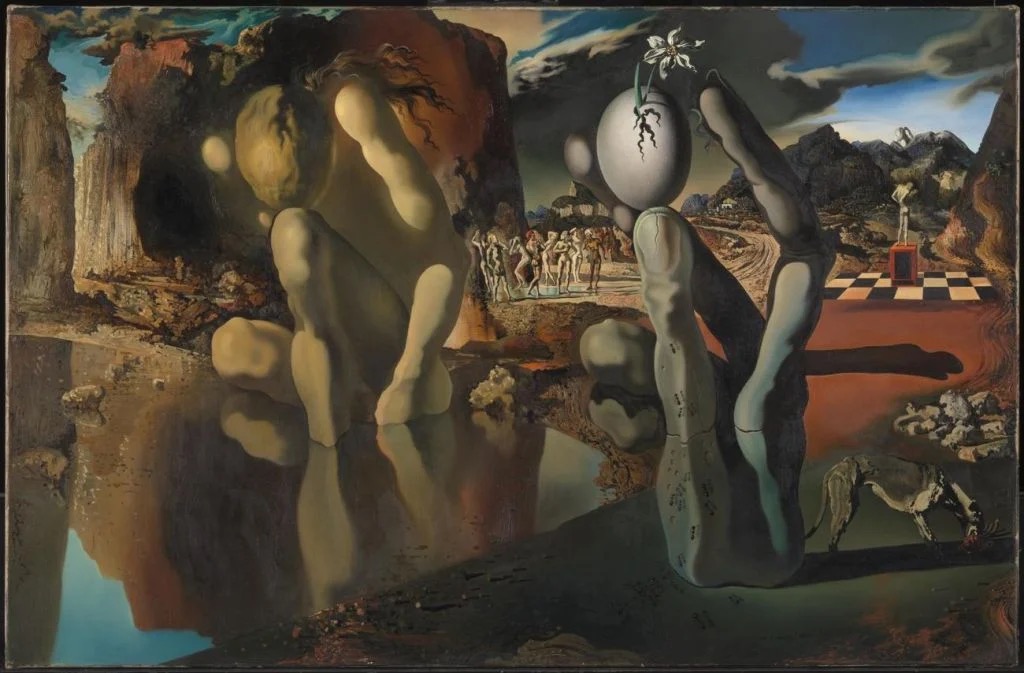
Salvador Dalí The Metamorphosis of Narcissus 1937 Oil on canvas 51.1 × 78.1 cm Tate Modern, London
Bibliography and references
Author's articles cited in the text
- Armando Di Nardo, "Borges, AI, and the Library of the Possible. Probability, possibility and creativity in the era of generative AI", Appunti Corsari, May 27, 2026. Read online
- Armando Di Nardo, "Social Dilemma. Tristan Harris, notifications and the Center for Humane Technology", Appunti Corsari, June 17, 2026. Read online
- Armando Di Nardo, "Stopping as an act of freedom. Why we read less and less, scroll more and more, and risk no longer having time to understand", Appunti Corsari, July 1, 2026. Read online
- Armando Di Nardo, "The agreement between Facebook and Instagram with American States: an epochal change. When time becomes a design problem", Appunti Corsari, August 31, 2026. Read online
Other essential references
- Jonathan Haidt, "The Devil’s Plan to Ruin the Next Generation", After Babel, December 1, 2025. Read online
- Snopes, reconstruction of Paul Harvey's versions, "If I Were the Devil". Read online
- U.S. Surgeon General, Social Media and Youth Mental Health: The U.S. Surgeon General’s Advisory, 2023. Read online
- National Academies of Sciences, Engineering, and Medicine, Social Media and Adolescent Health, 2023. Read online
- OpenAI, "How ChatGPT and our language models are developed". Read online